I’m using this post to kick off a series on Brotherhood. It’s one of those words which is becoming clichéd, so I want to try and describe what I mean when I use it here on this site. I think creating meaningful relationships with men is a lost art but a vital concept for men today. This series of blogs will highlight how I am working this out in my own life with the men I know. To kick off the series, I’ve updated an earlier post…
Something in men is crying out for brotherhood. Brothers are just as important as fathers in the development and growth of authentic men. Brothers are peers and helpers, rather than mentors and authorities.
Men need someone in the trenches with them, getting muddy and bloody, sharing the pain and victory alike.
All men need a brother: a man who says, I’ve got your back. A man who will be honest, a man who will come to their aid, to take a bullet for them.
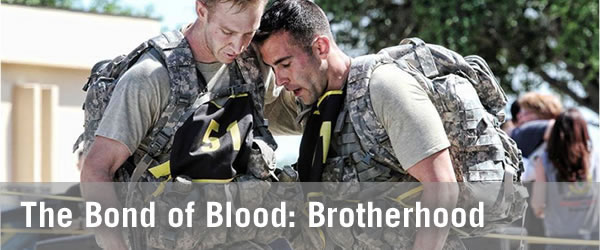
I’ve found that the men I’ve fought beside in war—even though we come from different backgrounds, different skills, and different lives—we still mesh together to fight and complete a mission. In doing that mission together, day in and day out, living and breathing together, we became brothers.
We used the downtime to learn about each other, we used the busy times to help and teach each other, and we used the trying times to test each other’s resolve and loyalty.
It was through these trying times I learned the most about my “brothers in arms.” What was important to him? Would he abandon his post or his mission? Would he sacrifice for others or for me? Would his ethics and values bend or break? Or would he be loyal to his brothers and to the cause?
The Warrior Ethos
In India, after years on campaign, the army of Alexander the Great threatened to mutiny. They were worn out and wanted to go home. Alexander called an assembly. When the army had gathered, the young king stepped forth and stripped naked,
“These scars on my body,” Alexander declared, “were got for you, my brothers. Every wound, as you see, is in the front. Let that man stand forth from your ranks who has bled more than I, or endured more than I for your sake. Show him to me, and I will yield to your weariness and go home.” Not a man came forward. Instead, a great cheer arose from the army. The men begged their king to forgive them for their want of spirit and pleaded with him only to lead them forward.
excerpt from Steven Pressfield’s book, The Warrior Ethos

Alexander physically displayed to his men that he was fighting and bleeding alongside them. Even as a leader, he was showing them that he was sacrificing for them, loyal to them, and willing to spill his blood for the common cause. This is how a true brother should act.
A Band of Brothers
Shakespeare’s rousing St. Crispen Day speech from his work Henry V is frequently used as an example of a leader inspiring his men to greatness, not by distancing himself from them, but by including himself in a larger brotherhood.
From this day to the ending of the world,
But we in it shall be remembered-
We few, we happy few, we band of brothers;
For he to-day that sheds his blood with me
Shall be my brother; be he ne’er so vile,
This day shall gentle his condition;
And gentlemen in England now-a-bed
Shall think themselves accurs’d they were not here,
And hold their manhoods cheap whiles any speaks
That fought with us upon Saint Crispin’s day.
Again, the key to true brotherhood is someone you would shed your blood with. In modern-day war, this bond is literally formed in blood. But it doesn’t have to be blood–it could be sweat and tears, or mud and dirt.
Brotherhood can be forged in many fields: Your office, your home, the world of non-profits, or your neighborhood.
Men need other men. We were not made as solitary creatures. We need parents, mates, and brothers. We need someone to fight the battles of life with.
Is there someone you would shed blood for? A man, a brother, a compatriot, that you will stick with, no matter what crap comes along? I hope so.
This is great, Dave. It makes me think of the Old Testament where they would “cut a covenant”. The covenant was sealed with blood, which is the strongest oath you can make.u00a0nnThe idea was to hold the covenant with blood, the very life force of your being. Blood brothers has that same connotation in that you would die (shed your blood) for your brother in the trenches. Those are the kind of relationships that I live for (and die for).
This is great stuff Dave!! Loved the example of Alexander! Great example of leadership!u00a0
Thanks Ben. u00a0I’m a history buff, but more recent history… so I need to read more on Alexander. u00a0Do you recommend anything?
Tony, that’s a great reference… thanks for adding to the discussion. u00a0u00a0nnI wonder if anyone does “blood brothers” anymore … maybe only after rigorous lab testing. ;^)
I am actually just thinking about getting into it! I need to find some myself!